Monday, 23 April 2012

Week 6-Landscape and the Sublime


THURSDAY, APRIL 19, 2012

Week 6-Landscape and the Sublime

'Wanderer in the mists' (1818) Caspar David Friedrich

'Untitled #2" (2002) Richard Misrach

 'Untitled # 394-03' (2003) Richard Misrach


Richard Misrach's photography reflects the concept of the Sublime, from the Enlightenment.

Research Misrach's work by reading about his intentions, and also by looking at the work. Then answer the following questions;

1. Define the Enlightenment, including its context (time and place).

The Enlightenment was a time period in which an intellectual revolution took place.  Known as a time of emergence from the darkness into a new age enlightened by reason and science. It challenged the beliefs and traditions of the monarchy and the nobility of the church. The Enlightenment spanned from the 16th century to the 19th. 

Some of the Enlightenment principles were: 
  • human perfectibility
  • equality
  • reason (good judgement)
  • power of thought and education
  • individualism
  • optimistic world view.
During the 18th century the newly affluent middle class throughout Europe and America challenged the vanities of Rococo style paintings because they did not reflect social responsibility and hardwork. The invention of the printing press in Europe in the 14th century allowed a rapid dispersion of knowledge and ideas.

The Enlightenment promoted Platonic ideas of human perfection prior to one being born, this went against the idea of the church's doctrine of original sin.

2. Define the concept of the Sublime.

The British writer Burke puts it this way: " The depiction of a terrible".

The famous British painter Constable's friend Wordsworth's, called it a "tranquil sublimity"  being one with nature inspired by means of enduring presence and calm harmony. "Terribilita" landscape emphasized the spatial infinity and elemental power of nature, on the other hand countryside scenes stressed the harmonious coexistence in a continuum of eternity.

3. Explain how the concept of the Sublime came out of Enlightenment thought.

Landscape paintings were not accepted by the Salon at that time, in fact those paintings were ignored by critics, it was considered to be unimportant. Rococo, Neoclassical and religious subjects topped the list of hierarchy for subjects. 

The Enlightenment moved away from traditional religious ideas of the church, similarly the sublime broke away from the stereo typical criteria of the Salon, to painting religious subjects.

The time of the Enlightenment was emerge from the darkness be an individual and not to be dictated by the churches. Therefore the concept of the sublime reflected this, the landscape paintings dealt with the idea that the life and spirit depended on a harmony within the larger order of the universe. 

Individualism was also a main idea of the Enlightenment, this is also reflected in the sublime where emphasis is put upon the individual and their relationship with the universe.

4. Discuss the subject matter, and aesthetic (look) of Misrach's work to identify the Sublime in his work. Include some quotes from art critics and other writers who have written about his work. 

Misrach's work definitely reflect the ideas of the sublime, his photographs are likened to the painting of the famous artist Turner. His subjects look like they are being completely engulfed by the nature surrounding them. However the subjects are at ease there is no danger, they are immersed in tranquility. 

By Blake Gopnik
Washington Post Staff Writer
Sunday, June 15, 2008 :"In Misrach's work, even images of figures lost in an infinity of water don't make us worry for their safety or sanity. They make us envy their leisure...These images assert a comfort with wild nature that we haven't always had. We now feel sure that we can tame it, use it, enjoy it, even endanger it at will".

Art review: Liz Magor and Richard Misrach at Henry Gallery :"The photographs look down at vast expanses of beach and ocean, composed as allover patterns or simple geometries. In some, a lone human figure or two sprawl on the beach, entwine or float in the surf far below. They exist to provide a trope, the notion of the tininess of human life in the grand scheme of things."


5. Add 2 new images of his work to your blog.
Untitled #1132-04 by Richard Misrach, 2004. Chromogenic color print


Misrach1994_18.jpg
White Man Contemplating Pyramids, Egypt, 1989-1991

6. Describe how does Misrach's photography makes you feel. How does it appeal to your imagination?

When I look at Misrach's photography I truly grasped the meaning of the sublime. Nature is powerful and as humans we often forget that. It also emphasizes the importance of having that connection or relationship with nature because we are both part of the universe and the grand scheme of things.

His photographs have an eerie feel to them, it makes me feel the immense power of nature, his subjects look vulnerable, but at the same time they are completely safe in nature's hands.

7. Identify some other artists or designers that work with ideas around the Sublime, from the Enlightenment era as well as contemporary artists.

John Constable was famous for his works with the sublime. He was known for landscape paintings, his dappled and painterly techniques. Constable painted farmers working in the countryside, his subjects scale would be very small in comparison to nature and the surroundings. Which are typical characteristics of the sublime.

Haywain - John Constable
Haywain- John Constable


William Turner was also a famous painter who worked with the ideas of the sublime he painted a few scenes showing the progress of the times and new inventions relating to nature. For example the invention of steam trains, in his painting "Rain Steam Speed" Turner paints the steam travelling through and nature is totally surrounding it as though it is being engulfed.

Rain Steam Speed- William Turner

8. Add a Sublime image of your choice to your blog, which can be Art or just a Sublime photograph.

Refer to examples above.

9. Reference your sources (books and websites)
See Honour 1979, .pg72 


Tuesday, 3 April 2012

Week 5 - The Social Status of the artist - The Renaissance and now.

SUNDAY, APRIL 1, 2012


Week 5 - The Social Status of the artist - The Renaissance and now.


Self Portrait in Fur Coat (1500)
Albrecht Durer

Knob (1997) Gavin Turk

Damien Hirst and Maia Norman (1995)


Albrecht Durer's 'Self-Portrait in Fur Coat' (1500) shows a significant change in the way that the artist views and portrays himself. Research the paintings by Albrecht Durer, Gavin Turk and Damien Hirst in order to answer
the following questions;

1. Identify aspects of Durer's self portrait that show a changing view of the artist's view of himself as an individual.

Durer portrays himself in a Christ-like figure he makes himself looks superior and righteous. During the time that Durer did his self portrait he had just rose to the upper class social circle. He is adorned in a fur-trimmed coat these coats were usually worn by humanists and patricians. There is clear evidence of geometry in his portrait and were everything is placed, he also adds a Latin inscription in the top right hand corner of the painting. Durer adds these mathematical and rhetoric elements to distinguish himself from the mere craftsman, rather he wants to be acknowledge as an intellectual labourer.  

2. Explain how the artist's social status increased during the Renaissance period. Briefly explain why this happened.

Around the 16th century there were a few artists who rose to fame two of them being Michelangelo and Raphael.The ideas of the "artist" changed, an artist was someone "who had made serious study of his art" as told by :The Elder Pliny's Chapters on the History of Art (1977). 

There was also a change in artistic patronage, Italian rulers and the papacy in Rome provided artist with gigantic projects which meant a big commission. This enabled artist to stop relying on the guilds and escape from them. The workshops had a rival; art institutions were started, where various artists would gather together for training in three arts; painting, sculpture and architecture.

Poetry was viewed as an intellectual skill, the reasoning arose that poetry and painting should be viewed as equal because both are created through the exercising of the imagination. Hence if poetry was seen as a liberal art  painting should be too. 

3. Comment on Gavin Turk's work in relation to individualism, status of the artist and egotism.

Turk's work "Knob" is a screenprint of the artist's signature. This relates to individualism because his signature is his trademark, his has printed on white wove there are no distractions around it the focus is solely on HIS name. 

Because this work is egotistical is shows that Turk thinks quite highly of himself, the print is so simplistic and it is what it is, he lets it speak for itself. In my opinion Turk is showing that he doesn't have to try to impress because he has already made a name for himself. 

4. Comment on Damien Hirst's use of his work and the media for self promotion.

Damien Hirst's works make a statement his collection of animal deal on quite a heavy subject matter. It get's people talking, he seems like quite an outspoken man and he sounds his ideas out through his art. He uses the media very well for self promotion as we see in the photo, Hirst is pictured there he looks gregarious and eccentric, I find him intriguing.


5. Find 2 images of work by any artist or designer that reflect some of the ideas of individualism, self promotion or egotism that have been discussed on this blog. Upload images to your blog, title and date the work, identify the artist/designer and comment on the work in relation to the question.

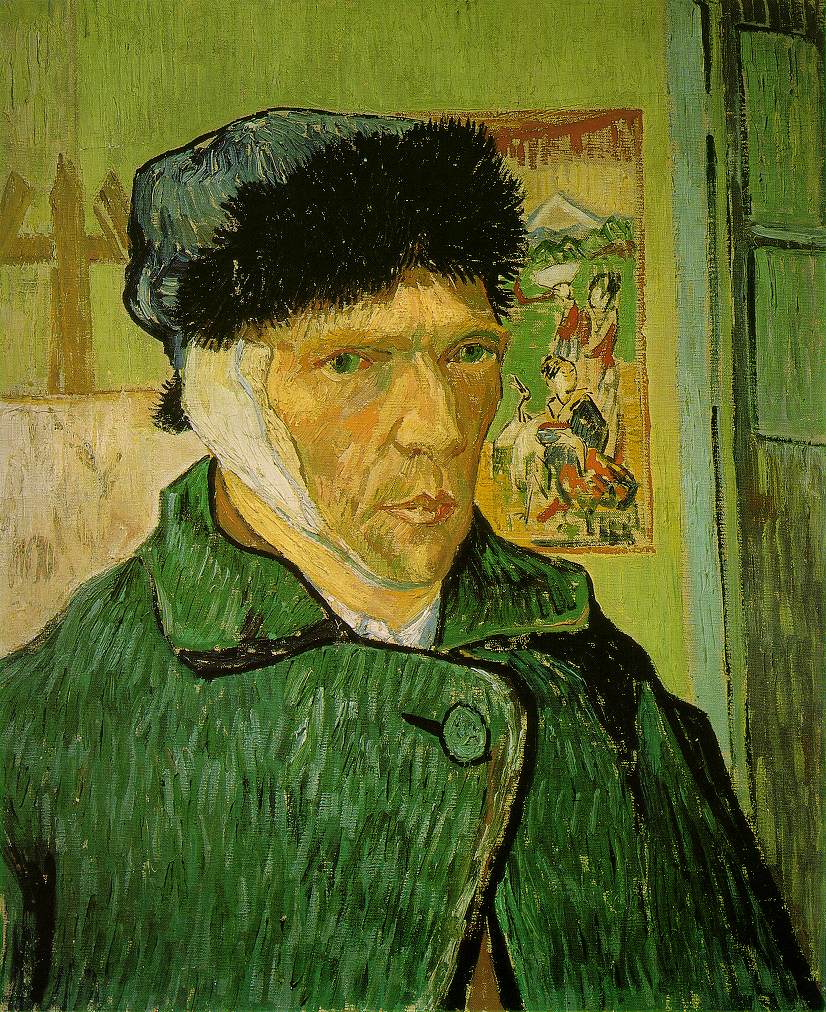
In his portrait Van Gogh has painted himself in a very vulnerable state, it shows his fragile state of mind. It was rumoured that Van Gogh had cut of his own ear to prove a point to someone. Van Gogh's self portraits can be seen as self promotional he is known for his many portraits of himself.  


Henri Matisse. Self-Portrait in a Striped T-Shirt.

Self Portrait (1906) Henri Mattise


This is the most well known self portrait of Mattise, the artist gazed right at you he looks confrontational. He paints himself in a striped T-shirt that was most commonly worn by fishermen in that day. He presents himself as a "human being" rather than an  artist.  This portrait reflects the ideas of individualism because the artist is depicting just himself he has not add anything fancy to give his audience more information about him. His stare is enough to captivate someone. 


6. How do you think artists and designers are viewed in Western society today?


In my opinion artists and designers in the Western world today are well respected. They have the freedom to express themselves, their thoughts and ideas. Art is no longer seen as a lowly skill or talent compared to academic studies, it is viewed as equal.

The world needs artists and designers to make people's lives more interesting, Our environment is so diverse and ever changing, unlike the times in the Renaissance period there are no more rules our boundaries. Artists and designers are definitely not looked down on rather they have a place in society, and they can make their own mark .

8. Reference the websites and/or books you have used, at the end of your blog.
http://www.ibiblio.org/wm/paint/auth/durer/self/

http://employees.oneonta.edu/farberas/arth/arth200/artist/durer_intro.html

http://employees.oneonta.edu/farberas/arth/arth200/artist/durer_koerner.html#anchor436030

http://www.smk.dk/en/explore-the-art/the-royal-collections/french-art-1900-1930/highlights/henri-matisse-self-portrait/


Monday, 19 March 2012

Ron Mueck's sculpture and Humanism

THURSDAY, MARCH 15, 2012

Week 4 - Humanism and contemporary sculpture.

 Ron Mueck's sculpture and Humanism

Mask II (2002) Ron Mueck

A girl (2006) Ron Mueck


Ron Mueck has become internationally recognised for his unique sculptures, which replicate the human figure with unrivalled technical skill. His work has a powerful psychological range, focusing not only on universal experiences like birth, life and death but on emotional states such as isolation, fear and tenderness. His startling manipulations of scale are key to our experience of each work.

Mueck's work showed at the Christchurch Art Gallery from the end of 2010 through to January 2011. Research Mueck's sculpture in order to answer the following questions;

1. Mueck's sculpture is described as 'hyper-real'. Define the meaning of this term and explain how it is evident in his work.

When referring to art hyper real means that the work has been render in a detailed and photo realistic manner. The subject looks so real and life like. Mueck's sculptures are incredibly realistic and highly detailed.

2. Mueck says he is not interested in making life size sculpture. Find out why he is more interested in working with the scale of the figure which is not life size, and mention 2 works which use scale that is either larger or smaller than life.

Mueck likes to play with scale because he thinks that life size is ordinary and it is what we see everyday, it make you see it in a different way not as something that's just normal. 

"Big Man" is large in scale, "Spooning Couple" is small in scale. 

3. Define Renaissance Humanism , and identify which aspects of Humanism can be seen in Mueck's work. Note that the contemporary definition of Humanism is much broader than the Renaissance definition.

It is the rediscovery and re evaluation of classical civilization. Humanists had a large appreciation for ancient artifacts and would embark on journeys to go find these. They had an interest in Naturalism and anatomy. There was a shift from the church dictating peoples morals, rather the desire to be individuals increased.

Humanism is evidently seen in Mueck's work, he has rendered his sculptures in such a detailed way. The viewer experiences 3 dimensionality and perspective when looking at the figures. The figures are also naturalistic and tonally modeled, they look so life like and real.  All these characteristics are also clearly seen in Renaissance Humanism paintings.

4. Research and discuss one of Mueck's sculptures that you might find challenging or exciting to experience in an art gallery. Describe the work, upload an image of the work, and explain your personal response to the work. Comment on other student blogs to develop the discussion around the variety of our own personal and individual responses to art and design.

I appreciate the work "Two Women" a lot, and it would definitely be very exciting and captivating to see in person. The sculpture is of two frail women who are huddled together in conversation. They are smaller than life size, Mueck's describes them in great detail even adding thin stockings and the wrinkles on their skin. Although they are engaging in a private conversations it looks like they are fully aware that someone is listening. The intense facial expressions suggests that they are suspicious or paranoid. 

I find this work very interesting because the two women look fragile but at the same time I'm intimidated by their stern looking faces. It would be amazing to see them up close, it would send chills down my spine!


Reference websites and books used at the end of your blog.


http://www.metacafe.com/watch/816457/ron_mueck_australian_hyperrealist_sculptor/

christchurchartgallery.org.nz/exhibitions/ron-mueck/

Sunday, 18 March 2012

Damien Hirst work 'For the Love of God' and Mercantilism

WEDNESDAY, MARCH 7, 2012


Damien Hirst's work 'For the Love of God' and Mercantilism

For the Love of God(2007) Damien Hirst
Research Damien Hirst's work For the Love of God (2007) in order to answer the following questions;

1. Describe the work, giving details of the form and materials. 

The skull is made from platinum it is a cast of a real human skull, the teeth are also from the original skull. It is encrusted with 8,601 flawless diamonds. On the large forehead sits a pear-shaped diamond that is light pink in colour.

2. What does the work mean? What is Damien Hirst communicating in the work?

Subject matter is death, most of Hirst art is based around death. The artist says:  "Death is such a heavy subject, it would be good to make something that laughed in the face of it.” 


In "For the Love of God", Hirst take the ultimate symbol of death and embellishes it with luxury. So to say to "hell with death".

3. How does Hirst's diamond encrusted skull relate to Mercantilism and to conspicuous consumption?

There was the controversial matter over blood diamonds, the piece of work might have the potential to bring about death in a literal way. "That’s when you stop laughing,” Hirst says. “You might have created something that people might die because of. 

This work relates to mercantilism, but of the obscene amount of money that was spent towards sourcing the materials for it. It definitely classifies as conspicuous consumption, its outrageous and over the top.

4. How much did the work cost, and how much was it sold for, and who bought it?

It cost around 16-20 million to make, and is worth about $100 million pounds.

5. What are some of the differing opinions of the journalists in the newspaper and blog articles?
   What did they think of the work?

People were quite critical of his work saying that it was excessive and extravagant.

A writer of a magazine has a more mixed review of "For the Love of God", he makes the comment on the uncomfortable proximity of art and commercialism. He raises the question why if Hirst's work “embodies the fact that art works have become the crown jewels of our age” that “its aesthetic value remains uncertain.

Others receive Hirst's exhibition very well. It fascinates them and intrigues them. Some reviews embrace the decadence of "For the Love of God". One writer says:" I can't remember another art work that so perfectly embodies the cynicism and ambivalence successful artists must feel towards those who promote and collect their work. Part of what interests me so much about this whole project is the fact that Hirst is the main person who will profit by its sale. Confusing, but fascinating."


The Telegraph, For the love of art and money, Richard Dormen,12:01AM BST 01 Jun 2007.


6. Based on your research, what is your opinion of the work, as an object or a work of art.

Damien Hurst's work "For the Love of God" is very glamorous and extravagant. I like how outrageous it is. It makes a bold statement and get people talking which is what I like about the piece its controversial.


Its also visually attractive, and I like the meaning that the artist is trying to convey, about death and how terrible it is, but we don't have to view it in that stereo typical way. Rather we can retaliate and look at it in a different light.